

Product Description
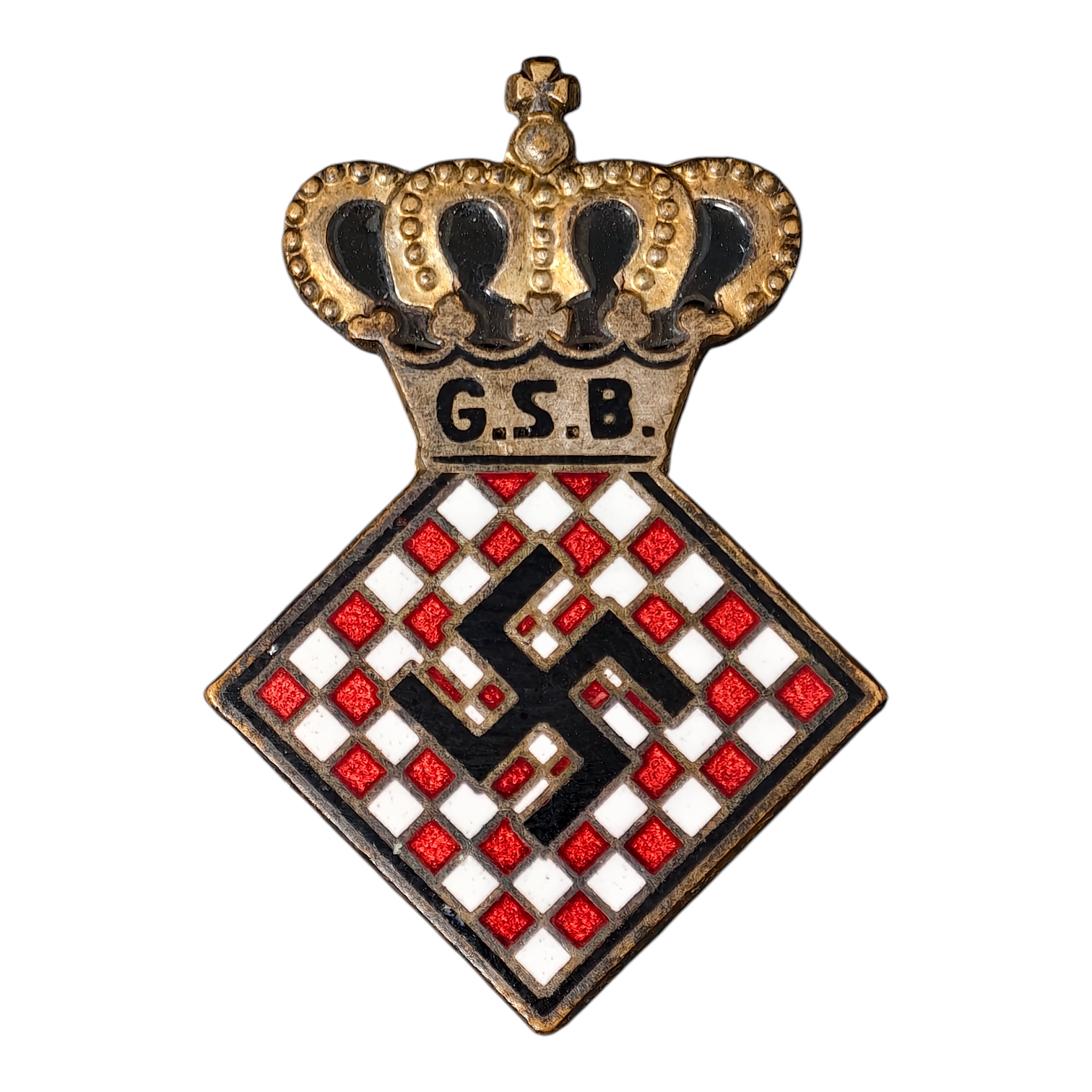
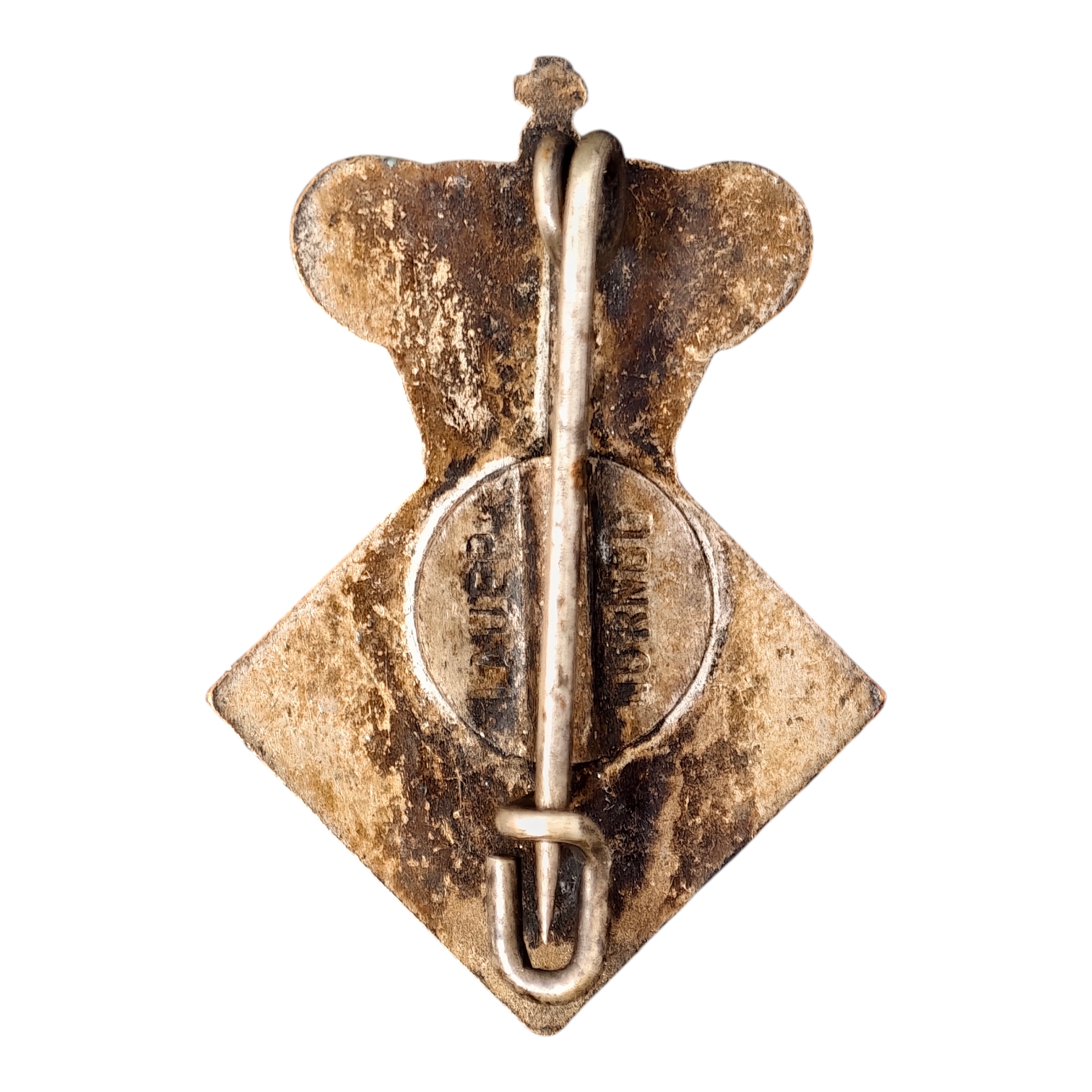
Nazi Grossdeutscher Schachbund Chess Membership Badge, a beyond rare piece .
The Greater German Chess Federation (GSB, sometimes also GDSB) was a National Socialist chess organization based in Berlin . The Greater German Chess Federation was the umbrella organization for German chess players from 1933 until the end of World War II .
At the beginning of the 1930s, only about one in four organized German chess players belonged to a member club of the German Chess Federation . The rest were organized in the party-politically oriented ( SPD , KPD ) workers' chess clubs, the chess departments of the German National Commercial Assistants' Association , and in several Catholic chess organizations, including the "Schachbund im Katholischen Jungmännerverband " (with around 4,000 members in 1933). Since dual memberships were possible, the total number of organized players at the end of the Weimar Republic can only be estimated at approximately 30,000 to 40,000 chess players. [ 1 ]
In this context, Berlin chess players founded another National Socialist chess association on December 13, 1931, which called itself the "Greater German Chess Federation." The name reflected the association's explicit appeal to chess players among Germans living abroad . Bruno Hartmann was appointed chairman. It was a purely politically motivated foundation. Nothing is known about any games or clubs that joined the GSB until 1933. [ 2 ]
After the Nazi seizure of power , the Nazi Party leadership pursued the goal of replacing the existing diversity in chess organizations with a unified organization under the umbrella of the GSB. The workers' chess clubs were banned from operating as early as early 1933; their members were often able to join other clubs.
The merger of the existing chess organizations into the Greater German Chess Federation was decided on April 23, 1933. This date was considered the founding date of the GSB in contemporary accounts. Otto Zander became the federal leader , and Ehrhardt Post was appointed managing director. At the end of May 1933, Joseph Goebbels assumed the honorary chairmanship of the GSB.
The German Chess Federation temporarily withdrew its consent and appointed a National Socialist official as its leader. The German Chess Federation's attempt to assert its independence in this way failed, and its replacement by the GSB was confirmed in July 1933. At the same time, the Greater German Chess Federation made its claim to leadership clear at its first congress in Bad Pyrmont . The regional associations and member clubs of the German Chess Federation were admitted to the GSB. They were required to hold extraordinary general meetings in July 1933, at which, if possible, a member of the Nazi Party was to be elected as "club leader." According to the Führer principle , this member appointed further staff members, such as a "deputy leader," a secretary, or a "team leader." [ 3 ] The German Chess Federation continued to exist legally until 1934. [ 4 ]
As a result of the Reich Concordat , which regulated the continued existence of Catholic organizations, the Catholic-affiliated chess organizations continued to lead a limited, separate existence until 1937/38. A similar situation applied during this period (until the November Pogrom of 1938 ) to the Jewish chess organizations, which had only been formed after 1933 as a result of the exclusion of Jews from the GSB (see below ).
After 1935, the GSB, as a nationwide organization, faced some competition from the chess community of the Nazi recreational organization " Strength Through Joy " (KdF). The KdF chess community, which also attempted to organize competitions and tournaments, was limited from 1938 onwards to taking on tasks in popular chess and, in particular, organizing company chess groups.
The GSB's publishing organ was the Deutsche Schachblätter , or in 1943/44, the only remaining German chess magazine, the Deutsche Schachzeitung .
The Greater German Chess Federation did not become part of the Nazi Party or any of its affiliated organizations . It was therefore forced to remove the swastika from its emblem at the end of 1933 [ 5 ] and thus could not claim any institutional funding.
Nevertheless, the Greater German Chess Federation pursued an intensive, politically motivated promotion of German chess, possibly influenced by the model of chess promotion in the Soviet Union . Larger events and "promotional weeks" were intended to increase interest in the game. In October 1934, Otto Zander reported that, compared to the approximately 10,000 members of the German Chess Federation in 1933, 45,000 to 50,000 players now belonged to the new federation. [ 6 ]
In addition to the ideologically motivated exclusion of Jews, the GSB pursued several key approaches. The competitive nature of chess was emphasized. For example, the conditions for awarding the championship title , which was to be awarded for only one year, were significantly tightened. The number of qualifying tournaments for the " Championship of Germany " increased, and supra-regional zones were established for tournaments above the state level. [ 7 ]
On the one hand, there was financial support for chess by the state, while at the same time the amateur nature of the game was emphasized. As a result, cash prizes were no longer offered at tournaments; instead, players were reimbursed for all participation costs. Finally, team chess experienced a resurgence, which included the hosting of the first German Team Championship .
In addition, there were efforts by officials and a number of National Socialist chess publicists to militarize chess in terminology (“combat chess”) and, after the outbreak of the war, to emphasize the psychological significance of the “intellectual defense game” for the war effort.
The GSB had stipulated in its statutes that it would accept "only Germans of Aryan descent" as members ( Aryan paragraph ). As early as the spring of 1933, all Jewish chess officials had to resign from their offices, above all the president of the German Chess Federation, Walter Robinow . As late as May 1933, Heinrich Ranneforth wrote in the Deutsche Schachzeitung : "Anyone who feels and acts German and thereby feels an inner connection to the German people, why should they not be considered a fellow citizen ?" But as early as July 1933, Jews were no longer allowed to be members of chess clubs within the GSB. For example, the former world chess champion Emanuel Lasker had to be expelled from the Berliner Schachgesellschaft , of which he was an honorary member. [ 8 ] During this time, several purely Jewish chess clubs were founded, some of which lasted until 1938. In 1935 and 1937, "Jewish Championships" were even held, won by Sammi Fajarowicz .
Starting in 1936, the GSB published a series of publications entitled "Library of the Greater German Chess Federation." In these publications, some opening variations named after Jewish chess players were renamed, and all the games printed therein with Jewish participation were won by "Aryan" masters. This deprived readers of many of the best chess games, since the leading chess players between 1880 and 1930 were largely Jewish.
In the spring of 1941, when the German-Soviet non-aggression pact was still in effect, a series of articles by then-world champion Alexander Alekhine appeared in two magazines entitled "Jewish and Aryan Chess: A Psychological Study Based on Experiences at the Black-and-White Board Demonstrates the Jewish Lack of Courage and Creative Power." The article was intended to prove that "Aryans" were better chess players due to their aptitude—especially their "fighting spirit." Alekhine, who had also received financial support from Germany after 1941, left the German Reich in 1943 due to the developments of the war and settled in neutral Spain.
Such theoretical attempts were accompanied by the martial-racist rhetoric typical of the time in official documents. For example, the invitation to the 23rd Swabian Chess Congress in June 1941 read: "For the second time in this great struggle of National Socialist Germany against its plutocratic-Jewish enemies, the Württemberg-Hohenzollern Chess Association calls its members to a wartime chess congress."
In his 1943 essay "Chess – Combat and Art," published in the Deutsche Schachzeitung (German Chess Newspaper), Emil Joseph Diemer wrote : "I see in this fear of responsibility, of risk, of great deeds, of living dangerously, the ultimate expression of Jewish influence on our chess youth. Why should it be any different in chess, this symbol of human life, this parallel phenomenon to all human conflicts in the cultural and political spheres, than in all other areas of contemporary human existence? Here, combat, here, the Maginot spirit!"